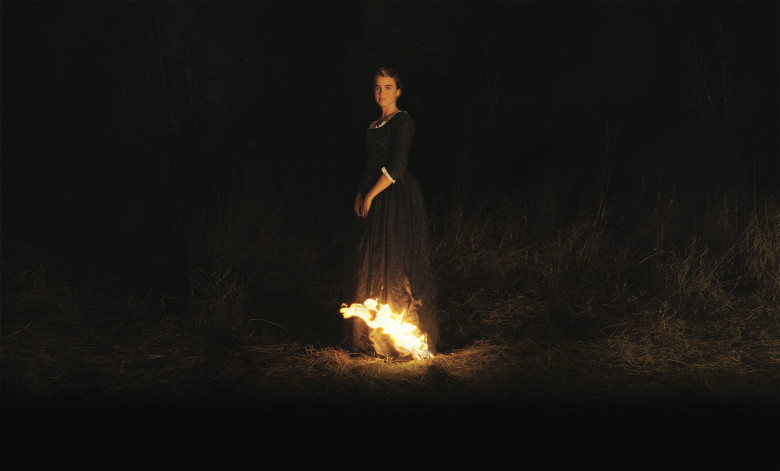

Recently, I’ve found myself discovering a great sense of appreciation for even the most minuscule parts of movies. Whether it’s the performance of an actor, the beautiful shots that will stay with me forever, or the score that managed to entrance me even further into the story than I thought possible. To put it plainly, I didn’t have to pick one for this movie. Just as a disclaimer there will be spoilers in this review, and I very much implore you to go and see this film. It’s stolen a very significant place in my heart.
Every single moment in this film lingered not only in my mind but on-screen with the longing that could be felt between Marianne and Héloïse throughout their forbidden romance. I sat with intense anticipation as Marianne followed behind a cloaked Héloïse, whose face had yet to appear on-screen, and the gorgeous shot of her reveal once she turned around still sits with me. Céline Sciamma’s direction was so good that it’s sort of beyond my capacity of comprehension how she did this.
I’m actually having some difficulty in writing this review because of how good this movie was, how well-written the story was, and how badly I now want to revive my high school French knowledge so that I can watch it again and understand the beauty of this romance without translation. Adèle Haenel and Noémie Merlant gave two of the most brilliant and truthful performances of 2019 in my opinion. This movie hurt me but also provided me with enough catharsis to feel inspired to go into the rest of my week. This movie dwelled and thrived in the unsaid. Every moment, every glance, gave way to a breadth of emotion that is by no means easily put on or captured.
After finishing the movie, I thought back to the scene when Héloïse was reading the story of Eurydice (a Greek Myth that I was particularly familiar with) and realized the stunning parallel to the ending of the story of their romance. After being haunted by the image of Héloïse in a wedding gown throughout the film, when Marianne is leaving Héloïse calls out to her, asking her to turn around and look at her before vanishing into the darkness. Earlier in the film, Héloïse theorized that Eurydice asked for Orpheus to look back at her, sending her back to the underworld to die a second time, never to see him again, and as some prophecy for the fate of their forbidden romance, Héloïse does the same. It was stunning, to say the least.
Portrait of a Lady on Fire is a beautiful, poignant, display of the artistry of story, with a message of feminism and love that stretches from the late 1700s to today with an honesty and vigor that will make this a piece that will never grow old. I truly hope that international films only continue to get more and more recognition following the deserved success of Parasite, because it’s truly an injustice to miss out on amazing films like these all over having to read captions.
Stories are as universal as the human experience, and movies like Parasite and Portrait of a Lady on Fire are only a couple of examples mixed in with the many that truly deserve to be seen and regarded despite the hold that the US has on the world of cinema. I absolutely loved this movie, and I hope you did (or will) too.
10/10.
Disclaimer: I do not own the image I’ve used here, nor do I have any intention of taking credit for it.
 allestory